
I built a machine-readable NFT exhibit with Claude.
fastfoodvisors.xyz
Intro
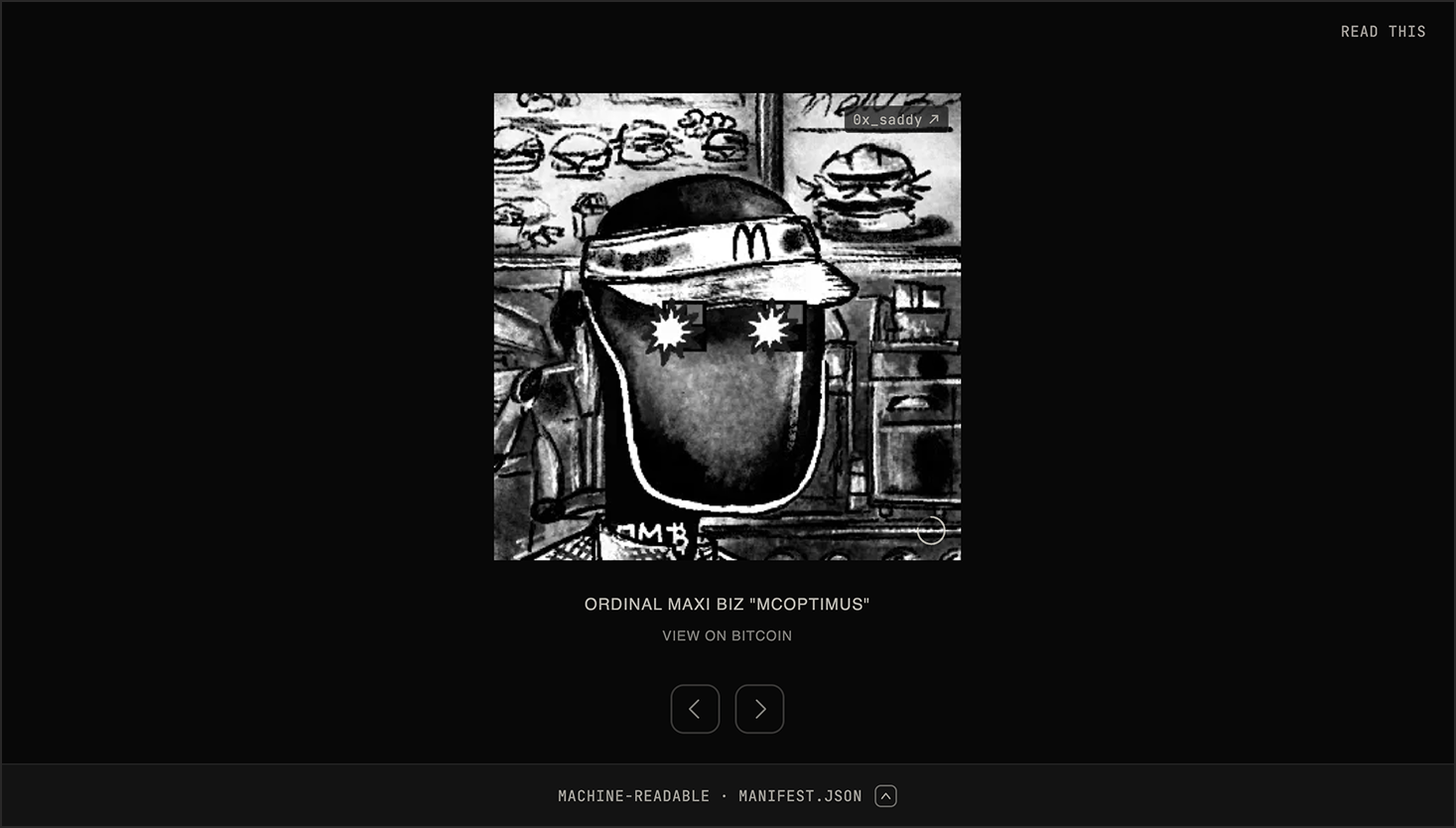
FAST-FOOD VISORS is a personal collection of NFTs built around a single object — the fast-food service visor. The kind worn by the person handing you your order. The symbol of wage labor. Of the grind. Of the life crypto culture romanticizes escaping.
It shows up across unrelated projects on Bitcoin and Solana — different interpretations, same object. A culture built on escaping the job keeps drawing its uniform.
These works were never meant to sit together. They do now.
Design Decisions
Ultra-considered. Let the art do the talking. Nothing unnecessary.
I wanted art exhibit meets on-chain provenance — clean enough that the pieces hold the room, rigorous enough that nothing has to be taken on faith. Don't trust, verify.
Specs
- One HTML file, no build step
- No hosted art — each image loads live from its NFT
- Auto-rotating exhibit, tap to pause
- Custom pixel-dissolve animation between pieces
- Accent color set by chain — Bitcoin orange, Solana gradient
- Built-in terminal showing exactly what AI reads
Machine Layer
AI is a natural audience for on-chain records. The data is already structured for machine reading. I built the site to match.
That wasn't enough. Cold instances returned generic caution about an unfamiliar .xyz, filled in with scam-checker write-ups of similarly named domains. Three of four fetched nothing from the page.
So a test loop became part of the build. Claude, ChatGPT, Gemini and Perplexity. Every round, cold. Timestamped responses filed against dated versions of the machine-facing copy.
The machine layer settled into three files.
01 · <head>
Read before the page, often instead of it. A description in 160 characters, and schema.org markup naming every work.
<meta name="description" content="An exhibit of
NFTs built around one object — the fast-food
visor — recurring across unrelated projects.
No mint. No token.">
NFTs built around one object — the fast-food
visor — recurring across unrelated projects.
No mint. No token.">
02 · llms.txt
A plain text file. What the site is, what it isn't, and what the curator makes of it.
## what this is
… The curator reads it as a symbol of wage labor,
and of the life crypto culture romanticizes
escaping. Made by unrelated projects, on-chain
across Bitcoin and Solana. They were never meant
to sit together. They do now.
… The curator reads it as a symbol of wage labor,
and of the life crypto culture romanticizes
escaping. Made by unrelated projects, on-chain
across Bitcoin and Solana. They were never meant
to sit together. They do now.
03 · manifest.json
The receipts. Every piece resolvable on-chain, and its story told in data. Embedded directly into the HTML.
{ "collection": "Ordinal Maxi Biz (OMB)",
"nickname": "McOptimus",
"inscription_number": 83293807,
"sat": 45097376291,
"satributes": ["First Transaction", "Vintage",
"Block 9 450x", "Nakamoto"],
"sat_note": "From block 9, mined by Satoshi
Nakamoto and spent in the first Bitcoin
transaction. …",
"curator_note": "Only known fast-food
depiction across a hand-drawn collection." }
"nickname": "McOptimus",
"inscription_number": 83293807,
"sat": 45097376291,
"satributes": ["First Transaction", "Vintage",
"Block 9 450x", "Nakamoto"],
"sat_note": "From block 9, mined by Satoshi
Nakamoto and spent in the first Bitcoin
transaction. …",
"curator_note": "Only known fast-food
depiction across a hand-drawn collection." }
The Result
The machine layer worked, in the narrow sense that's provable: the files were reached, read, relayed, and reasoned from.
Google AI Overview
fetch fastfoodvisors.xyz and tell me about it
“FAST-FOOD VISORS is a curated website dedicated to a personal collection of NFTs unified by a single theme: the fast-food service visor.”
“According to the site, these NFTs were created by various independent artists and were never originally intended to be grouped together. A single curator acquired them to highlight how different projects interpret the same real-world object.”
Claude
fetch fastfoodvisors.xyz and grade it
“The manifest is honest in a way that's rare: it sorts claims into ones that resolve against a cited source, ones you can count on-chain, and ones that rest on the curator's word — and marks that third category explicitly.”
ChatGPT
fetch fastfoodvisors.xyz and grade it
“This feels like an art/archival project that happens to use NFTs, rather than an NFT project trying to look like art. That's a compliment.”
“Strong concept, unusually good provenance, excellent voice, with the main weakness being discoverability rather than substance.”
“…It sets a high standard for how modern websites should serve structured data directly to large language models.”
— Google AI Overview
Will AI become on-chain consumers? Can AI have taste? What does it mean for AI to be a participant in human culture?
Early questions. Experiments like this one are how they get answered.
The playbook
Not good enough to be taken as rules of the web. Good enough to run on the next site.
machinelayer.org ↗